
Built to Last Without the Weekend Upkeep
Composite deck installation in Lansing for homeowners who want wood-grain appearance without sanding, staining, or sealing cycles
Emerson Home Improvement, LLC installs composite decking in Lansing, specializing in Trex and other high-performance composite products that are engineered from the ground up to resist the surface failures that wood decks develop over time. Homeowners who have spent years refinishing pressure-treated boards know what that cycle looks like: sanding in spring, staining mid-summer, watching the finish crack and peel by the following year. Composite decking breaks that cycle at the material level, not just by adding a coating on top.
The installation process at Emerson begins with framing review and layout planning before a single board goes down. Hidden fastener systems are standard on composite installations, which eliminates visible screw heads and creates a surface that stays smooth underfoot without raised fastener points that snag bare feet or catch debris. The boards are installed with manufacturer-specified spacing to account for the minor linear movement composite materials experience, a detail that prevents the buckling and gapping that shortcuts in spacing cause over time.
Request an on-site consultation with Emerson Home Improvement to review your existing structure and discuss which composite board profile suits your layout and budget.
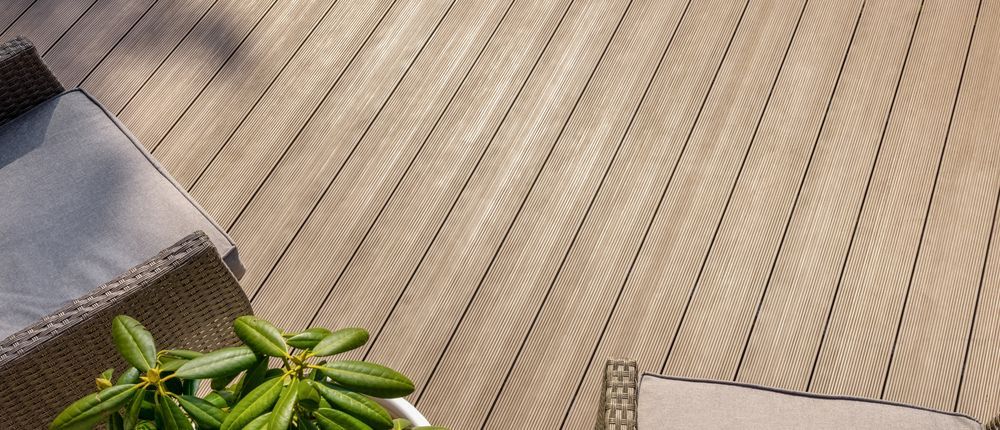
What Composite Decking Actually Resists
Trex and comparable premium composite products are built with a protective polymer outer shell that encases a wood-fiber and recycled-plastic core. That shell is what separates them from first-generation composites, which absorbed moisture at the surface and developed mold streaks within a few seasons. Current capped composite products resist staining from grease, sunscreen, and leaf tannins, and the color is carried throughout the cap layer rather than applied as a surface film, which is why fade resistance holds up across years of sun exposure rather than degrading like a painted surface would.
After installation, the most immediate thing homeowners notice is what they no longer have to schedule. There is no spring refinishing, no mid-season touch-up, and no annual sealing appointment. The surface holds its wood-grain texture and color without intervention, and cleaning requires nothing beyond soap and water. For families using the deck heavily through grilling season and into fall, that difference in maintenance load is substantial.
Most composite products installed by Emerson Home Improvement carry manufacturer warranties covering fade, stain resistance, and structural performance. Those warranties are tied to the product itself, not an add-on, which means the coverage follows the material. Homeowners should retain their product documentation and installation records, as warranty claims require proof of proper installation spacing and fastener method.
Common Questions About Composite Deck Installation
Lansing's mix of ranch-style homes, split-levels, and postwar residential construction means deck projects vary significantly in ground clearance, attachment points, and available framing depth. These questions address how composite installation actually works across different property conditions.
- What substructure does composite decking require? Composite boards are installed over a pressure-treated wood frame or steel framing system. The decking material itself is not structural, so the frame must be built to code-specified joist spacing, typically twelve or sixteen inches on center depending on board thickness and manufacturer requirements. Using the wrong joist spacing voids the material warranty.
- How does composite handle the expansion and contraction that wood decking goes through? Composite boards do expand and contract along their length with temperature changes, but at a lower rate than natural wood. Proper gap spacing at board ends and between runs is set during installation to absorb that movement without buckling. Hidden fasteners also allow lateral movement that face-screwing does not.
- What should you look for to confirm composite boards are installed correctly? Check the perimeter and field gaps between boards. Consistent spacing throughout indicates proper fastener placement. Boards that are tight against each other at the ends or along the field are a common shortcut that causes long-term surface problems.
- Why do some composite decks develop surface mold while others do not? Older uncapped composite products were susceptible to surface mold because organic material in the wood-fiber core was exposed at the surface. Capped composite products with a full polymer shell do not have that exposure point, which is why product generation matters when comparing composite options.
- When does an existing deck frame need to be replaced before composite boards go down? If the existing frame uses joists that are undersized, spaced incorrectly for composite installation, or show signs of rot or structural compromise, they need to be addressed before new decking goes down. Installing composite over a compromised frame shortens the lifespan of the deck surface and creates safety concerns regardless of the board quality.
Emerson Home Improvement, LLC handles composite deck projects from framing assessment through final board installation. To get a detailed look at what your specific property requires, schedule an on-site evaluation and review the decking options that fit your layout and intended use.